
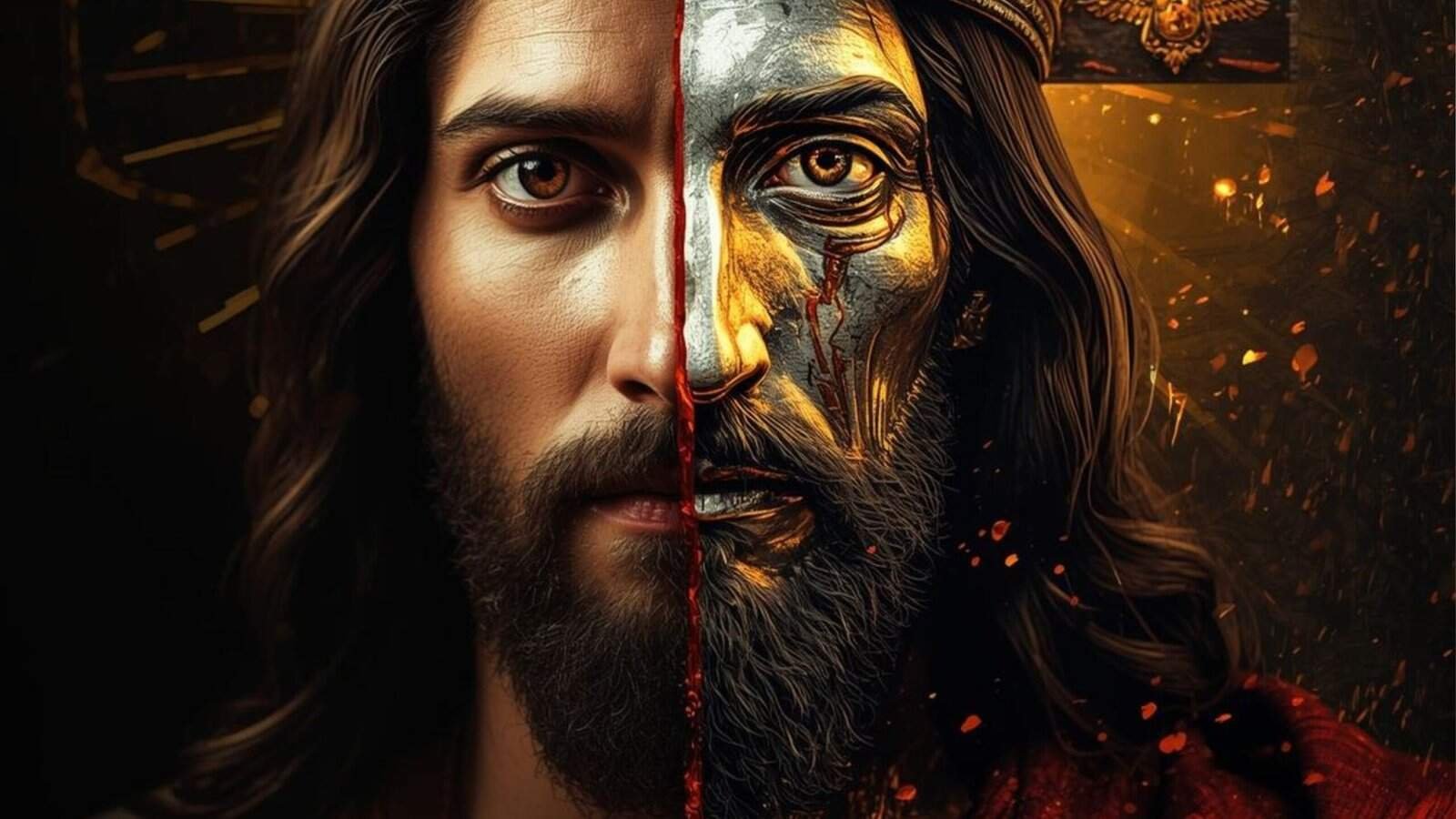




A reality check for believers
There's a Jesus in the Gospels—the one who actually walked dusty roads in occupied Palestine. He came to a people whose physical lives were governed by a ruthless empire and whose spiritual life was ruled by a strict and demanding hierarchy. He touched lepers, spoke with sex-workers and ate with tax collectors. Jesus challenged religious authorities and wept over Jerusalem, a temple city he saw s having gone all the way wrong.
And then there's another Jesus—one retrofitted to baptize nationalism, bless power structures, and sanctify the power of the strong over the weak while blessing the accumulation of wealth with divine approval.
These are not the same person.
For those of us who feel spiritually homeless because we can't reconcile what we read in Scripture with what we see celebrated in certain corners of American Christianity, here's a side-by-side look. Not to score political points or pick a side, but to reclaim clarity about who Jesus actually was and what he actually said.
On Power and Domination
Gospel Jesus:
- "You know that the rulers in this world lord it over their people, and officials flaunt their authority over those under them. But among you it will be different. Whoever wants to be a leader among you must be your servant." (Matthew 20:25-26, NLT)
- Washed his disciples' feet at the Last Supper
- Told Pilate, "My Kingdom is not an earthly kingdom" (John 18:36, NLT)
- Described his mission: "The Spirit of the LORD is upon me, for he has anointed me to bring Good News to the poor. He has sent me to proclaim that captives will be released, that the blind will see, that the oppressed will be set free" (Luke 4:18, NLT)
Empire Jesus:
- Blesses military might and celebrates strongman leadership
- Champions American exceptionalism as divine mandate
- Conflates national power with God's kingdom
- Promises dominion over enemies and victory through force
On Immigrants and Outsiders
Gospel Jesus:
- Was himself a refugee (fled to Egypt as an infant to escape Herod's genocide)
- Made a Samaritan—a despised ethnic outsider—the hero of his most famous parable
- Said "I was a stranger, and you invited me into your home" is the measure of righteousness (Matthew 25:35, NLT)
- Healed the Roman centurion's servant and praised the centurion's faith (Matthew 8:5-13, NLT)
- Extended his ministry to Gentiles, breaking down ethnic barriers
Empire Jesus:
- Positions brutal enforcement as Christian duty
- Views compassion for immigrants as weakness or naivety
- Prioritizes political agendas over "the least of these"
- Treats ethnic and cultural purity as virtuous
On Wealth and Economics
Gospel Jesus:
- "No one can serve two masters. For you will hate one and love the other; you will be devoted to one and despise the other. You cannot serve God and be enslaved to money." (Matthew 6:24, NLT)
- "What sorrow awaits you who are rich, for you have your only happiness now." (Luke 6:24, NLT)
- Told the rich young ruler to sell everything and give to the poor (Mark 10:21, NLT)
- Said "it is easier for a camel to go through the eye of a needle than for a rich person to enter the Kingdom of God!" (Matthew 19:24, NLT)
- Drove money changers from the temple with a whip (John 2:15, NLT)
Empire Jesus:
- Blesses accumulation of wealth as a sign of God's favor
- Promotes prosperity gospel: faithfulness = financial success
- Defends economic systems that concentrate wealth
- Views poverty as primarily a character failure
On Violence and Enemies
Gospel Jesus:
- "But I say, love your enemies! Pray for those who persecute you!" (Matthew 5:44, NLT)
- "Put away your sword... Those who use the sword will die by the sword." (Matthew 26:52, NLT)
- "God blesses those who work for peace, for they will be called the children of God." (Matthew 5:9, NLT)
- Refused to call down fire on inhospitable villages (Luke 9:54-55, NLT)
- Healed the ear of the soldier who came to arrest him (Luke 22:51, NLT)
Empire Jesus:
- Sanctifies military violence as righteous warfare
- Views enemies as beyond redemption, deserving only defeat
- Celebrates armed resistance and "standing your ground"
- Conflates Christianity with warrior culture
On Identity and In-Groups
Gospel Jesus:
- Told a Jewish lawyer that a Samaritan showed more righteousness than the priest and Levite (Luke 10:25-37, NLT)
- Said "many Gentiles will come from all over the world—from east and west—and sit down with Abraham, Isaac, and Jacob at the feast in the Kingdom of Heaven. But many Israelites—those for whom the Kingdom was prepared—will be thrown into outer darkness" (Matthew 8:11-12, NLT)
- Challenged ethnic supremacy: "God can create children of Abraham from these very stones" (Matthew 3:9, NLT)
- Expanded his mission beyond Israel's boundaries
Empire Jesus:
- Defends white cultural dominance as God's order
- Views Christianity as essentially Western/European
- Promotes racial hierarchy
- Treats cultural assimilation as a prerequisite for acceptance
On Women and Gender
Gospel Jesus:
- Spoke with women publicly (shocking for his culture)
- Had women among his traveling disciples (Luke 8:1-3, NLT)
- Appeared first to Mary Magdalene after resurrection, making her the "apostle to the apostles"
- Defended the woman caught in adultery (John 8:1-11, NLT)
- Praised Mary for sitting at his feet learning, rather than serving (Luke 10:38-42, NLT)
Empire Jesus:
- Enforces rigid patriarchal hierarchies as divine mandate
- Reduces women to supporting roles, primarily domestic
- Views male authority as natural order rather than cultural construct
- Weaponizes "biblical manhood" to justify dominance
On Religious Authority and Certainty
Gospel Jesus:
- Reserved his harshest words for religious leaders: "Outwardly you look like righteous people, but inwardly your hearts are filled with hypocrisy and lawlessness." (Matthew 23:28, NLT)
- Confronted those who "crush people with unbearable religious demands and never lift a finger to ease the burden" (Matthew 23:4, NLT)
- Condemned those who "shut the door of the Kingdom of Heaven in people's faces" (Matthew 23:13, NLT)
- Associated with the religiously excluded and ceremonially unclean
Empire Jesus:
- Demands absolute obedience to certain religious authorities
- Views questioning as rebellion or lack of faith
- Creates rigid boundaries around who's "really" Christian
- Weaponizes doctrine to control and exclude
On Suffering and the Cross
Gospel Jesus:
- "If any of you wants to be my follower, you must give up your own way, take up your cross daily, and follow me." (Luke 9:23, NLT)
- "If you try to hang on to your life, you will lose it. But if you give up your life for my sake, you will save it." (Luke 9:24, NLT)
- Modeled sacrifice, service, and suffering love
- Chose crucifixion over calling down legions of angels (Matthew 26:53, NLT)
Empire Jesus:
- Promises victory, dominance, and winning
- Views suffering as weakness or lack of faith
- Emphasizes power, success, and cultural dominance
- Trades the cross for a sword, service for a throne
Why This Matters
The Gospel Jesus threatens power structures, challenges nationalism, and consistently sides with the marginalized, the outsider, the powerless. He offers a kingdom "not of this world"—one built on self-sacrificial love, enemy-love, radical inclusion, and voluntary suffering.
Empire Jesus baptizes existing power structures, offering a Christianity that costs nothing, demands nothing, and changes nothing except the eternal destinies of individuals who pray a prayer.
One is the Jesus who got crucified by an empire for being too dangerous to the status quo.
The other is a safe Jesus who would never threaten any empire because he serves its interests.
You Cannot Serve Two Masters
Here's the hard truth: There is no middle ground. No hybrid Jesus. No way to blend the Sermon on the Mount with nationalist ideology and come out with something recognizably Christian or acceptable before God.
Jesus himself said, "No one can serve two masters. For you will hate one and love the other; you will be devoted to one and despise the other." (Matthew 6:24, NLT) He was talking specifically about God and money, but the principle applies to any competing loyalty—including nationalism, political power, or cultural dominance.
You cannot follow the Jesus who said "love your enemies" while celebrating those who demonize immigrants. You cannot serve the Jesus who blessed the poor while defending systems that crush them. You cannot worship the Jesus who washed feet while seeking dominance over others.
Empire Jesus is not "Jesus plus patriotism" or "Jesus plus strength" or "Jesus plus common sense." Empire Jesus is a false Christ—an idol carved in the image of power, dressed in religious language, but fundamentally opposed to everything the Gospel Jesus taught and embodied.
The Call to Choose
This is not about political parties or policy preferences. This is about discipleship. About who we're actually following.
The Apostle Paul warned about this: "I am afraid that just as Eve was deceived by the serpent's cunning, your minds may somehow be led astray from your sincere and pure devotion to Christ. For if someone comes to you and preaches a Jesus other than the Jesus we preached... you put up with it easily enough." (2 Corinthians 11:3-4, NLT)
We've put up with another Jesus for too long.
The real Jesus—the one in the Gospels—makes relentless, uncomfortable, costly demands. He calls us to enemy-love, not enemy-elimination. To self-sacrifice, not self-protection. To losing our lives, not securing our position. To taking up a cross, not wielding a sword.
This Jesus disrupts our comfort, challenges our assumptions, and refuses to baptize our tribal loyalties. He's always asking us to give up more than we want to give, love people we'd rather not love, and trust him instead of trusting power.
Practical Discipleship
So how do we ensure we're following the right Jesus? How do we guard against the slow drift toward Empire Christianity?
- Return to the red letters. Read the Gospels—Matthew, Mark, Luke, and John—repeatedly. Not proof-texting for your political positions, but letting Jesus's actual words confront and shape you. When your pastor, your political leaders, or your social media feed claim to speak for Jesus, compare their words to his. If they don't match, follow Jesus.
- Pay attention to who's being left out. Gospel Jesus consistently moved toward the margins—toward lepers, tax collectors, Samaritans, women, children, the ritually unclean. If your version of Christianity is more concerned with protecting your own status or that of the powerful than serving the vulnerable, you're following the wrong Jesus.
- Examine your allegiances. What makes you angrier—seeing Jesus's teachings violated, or seeing your political tribe criticized? When nationalism and the Gospel conflict, which one wins? Your answer reveals which Jesus you're actually following.
- Count the cost. Gospel Jesus promised suffering, not success. "In this world you will have trouble," he said (John 16:33, NLT). If your version of Christianity offers you power, cultural dominance, and victory over your enemies as the goal, it's not the Gospel. It's nationalism wearing a Jesus mask.
- Find others on the narrow path. You're not alone in this. There are other believers who've recognized the disconnect, who are choosing Gospel Jesus even when it costs them community, family relationships, or cultural belonging. Seek them out. Walk this path together.
The Choice Before Us
Empire Jesus offers certainty, power, cultural victory, and the satisfaction of defeating your enemies. He asks nothing of you except your vote and your voice in the culture war.
Gospel Jesus offers a cross, a call to love enemies, a demand to give up everything, and the promise that the last will be first. He asks for your whole life—your comfort, your security, your tribal loyalties, your very self.
You cannot follow both.
"No one can serve two masters." This isn't a suggestion. It's a statement of reality. Trying to hybridize these two versions of Jesus doesn't create a balanced faith—it creates a divided heart that serves neither.
The real Jesus is still there in Scripture, waiting. Brown-skinned Middle Eastern rabbi. Empire-critic. Friend of sinners. Lover of enemies. Washer of feet. Crucified servant.
He's not asking you to choose a political party. He's asking you to choose him—the real him, not the domesticated version we've created in our own image.
Which Jesus will you follow?
This is for the beleaguered believers—those who still love Jesus but can't stomach what's been done in his name. You're not alone. And the Jesus you're longing for? He's still there in the red letters, waiting to be followed rather than weaponized.



Mark Lynch says:
I so appreciate this post/article about Jesus and empire. I am a pastor of a small church in Ohio. I would love to share what I have learned from you with my congregation. Of course, I would give you full credit for what I have learned from you. Would you allow me to incorporate this information into a message for my congregation?
Faith Over Factions says:
Thank You for your kind words pastor. All the resources here are for the edification of the body, please feel free, and again, thank you.