The Doors Were Open
It is a Monday evening in San Salvador, March 24, 1980, and the chapel doors are open because the chapel doors are always open. It's hot. It usually is. A red car pulls up outside and waits. Inside, a sixty-two-year-old archbishop finishes a short homily about a grain of wheat and steps to the altar to prepare the bread and wine.
You probably know how this ends. What most people don't know is how unlikely the whole thing was.
Óscar Romero was supposed to be the safe choice. Cautious, bookish, a little stiff, wary of the activist priests around him and comfortable among the families who ran El Salvador. The men who helped put him in the archbishop's chair were relieved to see him there. Three years later they paid someone to shoot him at that altar. What happened in between is why his portrait hangs in this gallery. It's also why the portrait has a new section this year: the questions Romero was forced to answer in 1977 are being asked again, in his own country and in ours.
Who Was Óscar Romero?
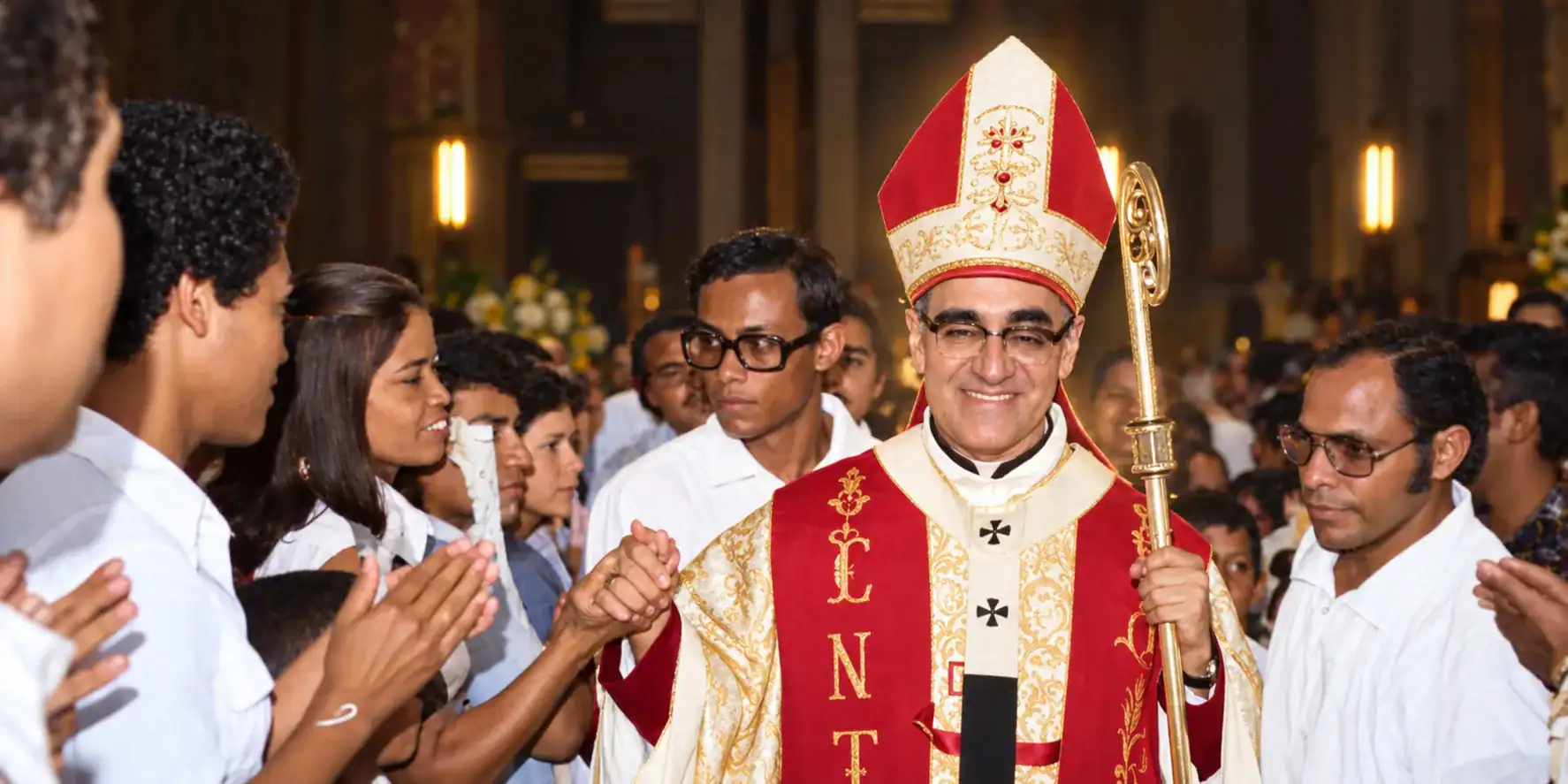
Saint Óscar Arnulfo Romero (1917–1980) was the Catholic Archbishop of San Salvador from 1977 until his assassination on March 24, 1980. Appointed as a safe, conservative choice, he became El Salvador's leading public voice against military repression, death-squad killings, and the abuse of the poor, using his nationally broadcast Sunday homilies to name the dead. He was shot by a single gunman while celebrating Mass in the chapel of the Divina Providencia hospital. A 1993 UN Truth Commission found that the killing was ordered by Major Roberto D'Aubuisson. Pope Francis declared Romero a martyr in 2015 and canonized him on October 14, 2018.1
Anchor in the Word
Key Scripture Verse
Speak up for those who cannot speak for themselves; ensure justice for those being crushed. Yes, speak up for the poor and helpless, and see that they get justice.
Proverbs 31:8-9 (NLT)
Key Scripture Context
Here's a detail that's easy to skim past: these lines were written for a king. Proverbs 31 opens with advice a mother gave her royal son about what a man with power owes the people who have none. She doesn't tell him to feel sorry for them, or to pray about them from a comfortable distance. She tells him to open his mouth.
The passage assumes the person listening has a voice that carries. Romero had one. An archbishop in a Catholic country, with a radio signal that reached nearly every village, held the one thing the murdered and the disappeared had lost: an audience the government couldn't easily switch off. Somewhere along the way he came to believe that voice was on loan, and it belonged to the people being crushed.
What We're Facing
The Safe Choice
Óscar Romero was born on August 15, 1917, in Ciudad Barrios, a mountain town in eastern El Salvador. His father wanted him to be a carpenter. The boy had other plans: minor seminary at thirteen, studies in Rome, ordination in 1942, and then three decades as a respected, hardworking, deeply devout priest who distrusted anything that smelled of politics.2
The Latin American church around him was splitting. After the bishops met at Medellín in 1968, many priests began gathering poor rural communities to read Scripture together and name the conditions they lived under. Romero didn't like it. He worried the gospel was being bent into ideology, and as a bishop he said so out loud.
So when the archdiocese of San Salvador came open in February 1977, the landowners and officers breathed easier. Here was a man who wouldn't make trouble. They offered him a fine house in one of the capital's wealthiest neighborhoods. He turned it down and asked the Carmelite sisters at the Divina Providencia cancer hospital, the hospitalito, whether he could live there as their chaplain.3 Nobody seems to have noticed what that said about him. Maybe he didn't either.
The Night at Aguilares
He'd been archbishop for less than three weeks. On March 12, 1977, his friend Father Rutilio Grande, a Jesuit who worked with peasant farmers in the parish of Aguilares, was ambushed on a country road and machine-gunned. An old man and a teenage boy riding with him died too.
Romero drove out that night and stood over the three bodies.
People who knew him call it the hinge of his life. Grande hadn't been a revolutionary. He taught farmworkers to read the Bible and to believe God saw them, and someone decided that was enough to kill him for.
What Romero did next looks, at first glance, like paperwork. He reached for the ordinary levers of his office and pulled them, one after another:
- One Mass. The following Sunday, March 20, he canceled every other Mass in the archdiocese and celebrated a single funeral Mass at the cathedral, so the whole church would be seen gathered in one place. Wealthy Catholics were furious about losing their parish Masses. A vast crowd came anyway.
- An empty chair. He announced the church would stay away from official government ceremonies until the killing was honestly investigated. It never was. He kept his word, right down to skipping the next president's inauguration.
- Somewhere to bring the evidence. He built up the archdiocese's legal aid and human rights work, so families had a place to report killings and disappearances and the church had documents instead of rumors.
Conversion stories usually stay inside the heart. Romero's showed up in the schedule, the guest list, and the budget.
A Pulpit That Read the Names
For three years his Sunday homily went out across the country on the archdiocese's radio station, YSAX. Surveys at the time suggested it was the most listened-to program in El Salvador. The station got bombed more than once. It kept coming back on the air.
The homilies ran long. They were patiently biblical and built the same way every week: the readings, what they meant, and then the week's events. That last part is what got him killed. He read out the names of people killed, tortured, or disappeared, with the place and the date, and when the evidence showed which unit did it, he named the unit.
He didn't stop at the government, either. When leftist guerrillas kidnapped and killed, those names got read too, along with his flat rejection of their claim that violence was the road to justice. That's why nobody could file him under a party. It's also why both sides, at different times, wanted him quiet.
In February 1980 he wrote to U.S. President Jimmy Carter and asked him not to send military aid to the Salvadoran security forces, because it would be turned on the Salvadoran people. The aid kept coming.2
The Last Sunday
March 23, 1980. After reading that week's list of the dead, Romero stopped talking to the men giving orders and started talking to the ones carrying them out: ordinary soldiers and national guardsmen, most of them poor kids from the same villages as the people they were shooting. He reminded them they were brothers of their victims. He told them no soldier is obliged to obey an order against the law of God. Then he said this:
In the name of God, and in the name of this suffering people whose cries rise to heaven every day more tumultuously, I beg you, I implore you, I order you in the name of God: stop the repression!
Óscar Romero, homily of March 23, 1980
The cathedral broke into applause. The men running the country heard something else: an archbishop telling the army to disobey.4
The Chapel
Which brings us back to Monday evening. The memorial Mass had been announced in that morning's paper, time and place included, so anyone who wanted to find him knew exactly where to look. He preached on the grain of wheat that has to fall into the ground and die before it can bear fruit.
Then he moved to the altar to begin the offertory. From the back seat of the red car outside, a gunman fired one rifle shot through the open doors. It hit Romero in the chest, near the heart. He fell at the foot of the altar crucifix and was gone within minutes. The car drove off.5
More than fifty thousand people came to his funeral on March 30. Bombs and gunfire broke out during the service, and dozens of mourners died in the panic. The civil war that followed lasted twelve years and killed at least seventy-five thousand people.4
Nobody has ever been criminally convicted of his murder. In 1993 the UN-sponsored Truth Commission concluded that Major Roberto D'Aubuisson, who later founded the ARENA party, gave the order. In 2004 a U.S. federal court found D'Aubuisson's security chief, Captain Álvaro Rafael Saravia, liable for the killing as an extrajudicial execution and a crime against humanity. By then Saravia had disappeared. He's never paid a cent.6
His death gets the attention, and fair enough. But the holiness came first, in three years of refusing to look away from the people Christ loved. The bullet only made it public.
What Prophetic Witness Is Not
A lot of people claim Romero who wouldn't have recognized themselves in him. So before going further, a few things he wasn't.
A partisan. He never endorsed a party or a candidate, and he wouldn't let the church become chaplain to the guerrilla movements any more than to the government. Killings on the left got named as plainly as massacres on the right. A voice that only ever finds fault in one direction is running a campaign.
A theorist. Romero wasn't an academic theologian and he didn't show up with a program. His positions grew out of what he saw: bodies, grieving mothers, tortured catechists. His episcopal motto was Sentir con la Iglesia, to think with the Church,
and he meant it to the end.
Looking to die. He knew he'd probably be killed, and he was afraid. He refused bodyguards, partly so nobody else would die alongside him, but he never went looking for it. Fear came along for the whole ride. He just didn't let it drive.
Loud for the sake of loud. His homilies were painstakingly researched. He named people, places, and dates, and his office worked to verify them first. Outrage without evidence is a gift to the powerful: it's so easy to discredit.
Someone who called every inconvenience persecution. Romero buried priests. The word resistance
only keeps its meaning if we don't spend it on small things.
Then and Now: Where Romero's Witness Meets 2026
Start with the difference, because it matters. El Salvador in 1980 was run by a military government whose death squads were murdering priests, catechists, and farmworkers by the thousands. Nothing below claims any government today is that government. Pretending otherwise would cheapen both eras.
The questions come back, though. In a few places they come back almost word for word.
In Romero's Own Country
Four decades after his death, El Salvador is living under suspended constitutional rights again. This time most of the country approves.
In March 2022, after gangs killed sixty-two people in a single day, President Nayib Bukele asked the legislature for a state of exception.
It suspended the right to know why you're being arrested, the right to a lawyer, and the privacy of your communications, and it let authorities hold people fifteen days before they see a judge. It was supposed to be temporary. It's been renewed every month since; the Inter-American Commission on Human Rights counted the forty-ninth extension in March 2026.7 More than ninety-one thousand people have been detained. That's over one percent of the population.8
Honesty requires the other column of the ledger, too. Gang violence and extortion have dropped dramatically. Neighborhoods that lived under gang rule for a generation are open again. Bukele's approval has rarely dipped below 80 percent.9 Plenty of Salvadorans who survived the gang years think the trade is worth it, and they've earned the right to their opinion.
The cost is real as well. In July 2026 Amnesty International reported that the emergency has hardened into a permanent system of mass arbitrary detention, with police officers describing arrest quotas and pressure to fabricate records, and concluded the abuses could amount to crimes against humanity.10 Human rights groups have documented hundreds of deaths in custody. In 2025 the legislature passed a Foreign Agents Law aimed at organizations with foreign funding, and Ruth López, an anti-corruption lawyer with the Christian human rights organization Cristosal, was arrested and held incommunicado.11 That July, Cristosal, founded by church leaders after the civil war, announced it was leaving the country after twenty-five years. Its staff, they said, faced a choice between exile and prison.12 The government denies any of this amounts to rights violations.
And the church? Divided, the way it was in Romero's day. The current Archbishop of San Salvador publicly backed Bukele's reelection and his crackdown on the gangs. He has also warned the government not to turn the country into a big international prison
after it agreed to hold deportees from the United States, and in August 2025 the country's bishops criticized the constitutional change allowing unlimited presidential terms.13 Cardinal Gregorio Rosa Chávez, a friend and close collaborator of Romero's, has gone further, describing the peace the state of exception has produced as the peace of a cemetery.14
This is where Romero's example cuts deepest, I think. Speaking against repression everybody hates is comparatively easy. Speaking against it when it's popular, when it's working by the measure most people care about, and when the people being swept up are ones the public has already decided are guilty: that's a different animal. Romero would have insisted the innocent among the arrested were still innocent and the guilty were still human beings made in God's image. And he wouldn't have felt any need to choose between gang victims and prisoners. He cared about both. By name.
In the United States
The second place these questions are coming back is closer to home for most folks reading this. The mass deportation campaign that began in 2025 has put immigrant families across the country into the kind of fear Romero's congregations knew well: raids, sudden disappearances into detention, families split without warning. Most of those families are Christian. Some deportees were sent to El Salvador's own mega-prison.
The U.S. Catholic bishops have responded in a way Romero would recognize. In November 2025 they issued their first special pastoral message in twelve years, telling immigrant families we stand with you in your suffering
and opposing indiscriminate mass deportation.15 In February 2026, bishops in border states called for an end to fear tactics in enforcement and insisted that detainees have access to Mass and the sacraments.16 Coverage of that statement cited one estimate that six in ten of the people targeted for detention are Catholic. On September 22, marking National Migration Week, the chair of the bishops' migration committee described families grappling with real fear and uncertainty.
17
Fairness matters here too. Catholic teaching, along with most Christian ethics, holds two things at once: people have a right to migrate to sustain their families, and nations have a right to regulate their borders, with justice and mercy. Reasonable Christians land in different places on immigration policy. Romero's example doesn't settle that argument, and I won't pretend it does.
What it does settle is narrower, and harder. Whatever the policy, the people it lands on have names. They aren't illegals
or aliens
or a number in a press release. The church's first job is to know who they are, stay near them, refuse the language that erases them, and tell the truth about what happens to them, even when the truth is awkward for whichever side you voted for.
Wherever You Are
Most of us will never stand in front of a national radio audience. That's all right. Romero's pattern scales down. Every town has people whose stories get told about them instead of by them. Every workplace, congregation, and family has moments when a popular consensus rolls right over somebody. His question walks into all of those rooms: who here can't speak for themselves, and what is my voice for?
A Better Way: The Romero Test
Five markers fall out of how Óscar Romero actually worked. They make a pretty good self-examination, and they apply no matter which side of the aisle you sit on.
Names, not categories. Romero read names, dates, and places. A category lets us approve of what happens to people in the abstract. A name makes that a lot harder.
Speaking when the injustice is popular. A stand that gets applause from everyone around you may still be right. It just hasn't been tested yet. Romero's hardest words went out to a country where many of the powerful, and much of his own church, wanted him silent.
Refusing your own side's violence. He condemned guerrilla killings even while the guerrillas claimed to fight for the same poor people he defended. If your convictions only ever catch the other team, they're loyalties wearing theology as a coat.
Talking to the one carrying out orders. His last appeal went to soldiers, not generals. Systems run on ordinary people doing their jobs. Speaking to their consciences, with respect, may be the most powerful thing a Christian voice can do. Also the most dangerous.
Living near the people you speak for. He turned down a mansion to live at a cancer hospital. Proximity keeps your words honest in a way good intentions can't.
Practical Moves of Faith
1. Learn Three Names
Romero's power came from specifics. Pick one group in your community whose story usually gets told by somebody else: detained immigrants, folks in the county jail, the unhoused, the shut-ins nobody visits anymore. Learn three actual names and three actual stories. A category is easy to ignore. A neighbor isn't.
2. Check Which Way Your Outrage Points
Write down the last three injustices that made you angry. Then ask, honestly, whether any of them involved people on your own side of the political divide. If none did, sit with that a while. Romero's credibility came from refusing to excuse anyone.
3. Verify Before You Speak
His office documented abuses before he named them from the pulpit. Before you share the story that confirms everything you already believe, check it. A false claim does more than embarrass you: it gives cover to the real abuses, because it teaches people to shrug off the next report.
4. Use the Levers You Actually Have
Romero changed a Mass schedule, skipped some state functions, and moved money around in a budget. You probably don't have an archdiocese. You have something, though: a vote at a church meeting, a role at work, a seat at a family table, a small corner of the internet. Figure out which decision is actually yours to make. Then make it.
5. Pray for Courage That Isn't Reckless
Pray it plainly: Lord, let me see the people You see, and give me the nerve to say what's true about them. Not recklessly. Faithfully.
Romero was afraid, and he walked to the altar anyway. Courage rarely shows up as a feeling first. Usually it's a choice you make with the fear still sitting right there beside you.
Supporting Scriptures
- John 12:24 (NLT):
I tell you the truth, unless a kernel of wheat is planted in the soil and dies, it remains alone. But its death will produce many new kernels—a plentiful harvest of new lives.
The theme of Romero's final homily, preached minutes before the shot. He wasn't predicting his own death so much as describing the shape of any faithful life. - Micah 6:8 (NLT):
No, O people, the Lord has told you what is good, and this is what he requires of you: to do what is right, to love mercy, and to walk humbly with your God.
Justice, mercy, humility: three things that go wrong fast when separated. Romero somehow kept all three in the same hand. - Isaiah 1:17 (NLT):
Learn to do good. Seek justice. Help the oppressed. Defend the cause of orphans. Fight for the rights of widows.
Every verb is active. Isaiah was talking to a deeply religious nation that was still getting this wrong, which ought to make all of us a little uncomfortable. - Luke 4:18 (NLT):
The Spirit of the Lord is upon me, for he has anointed me to bring Good News to the poor. He has sent me to proclaim that captives will be released, that the blind will see, that the oppressed will be set free.
Jesus' own mission statement. Romero didn't add the poor to the gospel. He found them already sitting at the center of it. - Matthew 5:10 (NLT):
God blesses those who are persecuted for doing right, for the Kingdom of Heaven is theirs.
Paying a price for justice can look like losing. Jesus calls it blessed. - Proverbs 21:3 (NLT):
The Lord is more pleased when we do what is right and just than when we offer him sacrifices.
Romero was killed while offering the sacrifice of the Mass, over the justice he preached from that same altar. Hard to find a sharper illustration of this verse.
The Part We Shouldn't Skip
An honest portrait has to include the parts that complicate the hero. Otherwise it's a poster.
He was late. Before San Salvador, Romero was bishop of the rural diocese of Santiago de María. In June 1975, National Guard troops killed several campesinos in the village of Tres Calles, inside his diocese. According to his biographer, he went to console the families and then wrote privately to the president instead of denouncing the killings in public.2 For years he'd also been a critic of the very priests whose witness he later took up, Rutilio Grande's style of pastoral work among them. It took a friend's murder to open his eyes to what had been sitting in front of him for a long time.
I find that the most hopeful thing in his whole story. A cautious, comfortable, institution-minded man changed, at fifty-nine. Most of us aren't Rutilio Grande. Most of us are the Romero of 1975, and the real question is what it's going to take to open our eyes.
His own church mostly left him alone out there. Of El Salvador's bishops, only one consistently stood with him during his three years as archbishop.4 Some of the others sent complaints about him to Rome. When he carried evidence of murdered priests to the Vatican, he didn't always find the support he'd hoped for. After his death, his cause for sainthood sat stalled for decades before anyone carried it through.
Not every famous Romero line is solidly his. The one printed on the most posters, If they kill me, I will rise again in the Salvadoran people,
reaches us secondhand, through a journalist's account of a telephone interview published after his death. It isn't in his homilies or his diary. It may well be authentic. Hard to say. His recorded homilies are more than enough to stand on, and they're firmer ground.
Justice never came. The man who ordered his murder died of cancer without ever being tried. The man who organized it has never been caught. El Salvador reopened the case in 2017, and it's still open. His story doesn't end with the wrong made right. It ends with the church telling the truth anyway.
Let's Walk This Out Together
Óscar Romero didn't start out as a prophet. He became one slowly: by opening his eyes, standing over the body of a friend, and deciding his voice belonged to people who had none. He was afraid and went to the altar anyway. He died there. His voice didn't. The United Nations now marks March 24, the day he was killed, as the International Day for the Right to the Truth concerning gross human rights violations and for the dignity of victims.
If something in this portrait stirred you, don't bury it. You don't have to drop it in a comment thread, either. The Faith Journal is a quiet, private place built for exactly this: honest writing, real prayer requests, and the questions you're not ready to say out loud yet. Free, private by default, no algorithm, nobody telling you what your doubt means. Write it there. Share it only if and when you want to.
One step for this week: read one of Romero's homilies all the way through. They're easy to find in English. Notice how much of each one is just Scripture, patiently explained, before he ever gets to the week's news. Then ask yourself what your faith would sound like if it named things that plainly.
And if you'd like to keep walking the gallery, Romero stands in the same line as Fannie Lou Hamer: Faith That Would Not Back Down, who also refused to stay quiet about what was done to her neighbors, and Dietrich Bonhoeffer: Faithful Unto Death, who also paid with his life. For a quieter, one-sentence kind of resistance, there's Karl Barth: Theology That Refused to Bow. Or start at the beginning with Portraits In Christian Resistance.
For the ones who've been looking away and know it.
For the ones who are afraid and going anyway.
For the ones whose names nobody reads.
Frequently Asked Questions About Óscar Romero
Who was Óscar Romero?
Óscar Arnulfo Romero (1917–1980) was the Catholic Archbishop of San Salvador from 1977 to 1980. Chosen as a cautious, conservative appointment, he became El Salvador's most prominent critic of military repression and death-squad violence after his friend Father Rutilio Grande was murdered in 1977. He was assassinated while celebrating Mass on March 24, 1980, and was canonized by Pope Francis on October 14, 2018.
Why was Óscar Romero killed?
Romero was killed because his nationally broadcast homilies exposed killings, torture, and disappearances carried out by El Salvador's security forces and allied death squads. The day before his death, he publicly called on soldiers to stop obeying orders to kill civilians and ordered the government, in the name of God, to stop the repression. The Catholic Church recognized him as a martyr killed out of hatred for the faith.
Who killed Óscar Romero?
The gunman has never been definitively identified or convicted. The UN Truth Commission for El Salvador concluded in 1993 that Major Roberto D'Aubuisson, a death-squad leader who later founded the ARENA party, ordered the assassination. In 2004 a U.S. federal court found Captain Álvaro Rafael Saravia, D'Aubuisson's security chief, liable for organizing the killing. No one has been criminally convicted.
How did Óscar Romero die?
On the evening of March 24, 1980, Romero was celebrating a memorial Mass in the chapel of the Divina Providencia hospital in San Salvador, where he lived. Just after his homily, as he began preparing the bread and wine for the offertory, a gunman fired a single rifle shot through the chapel's open doors. The bullet struck him in the chest and he died within minutes.
When was Óscar Romero made a saint?
Pope Francis declared Romero a martyr in February 2015. He was beatified in San Salvador on May 23, 2015, and canonized in St. Peter's Square on October 14, 2018. His feast day is March 24. At the canonization Mass, Pope Francis wore the blood-stained belt Romero had on when he was killed.
Was Óscar Romero political?
Not in a partisan sense. Romero never endorsed a party or candidate, and he condemned violence by leftist guerrillas as well as by the government and death squads. He understood his defense of the poor as a direct demand of the gospel rather than a political program. His critics on the right called him a Marxist; some on the left thought he did not go far enough.
What does Óscar Romero's example mean for Christians today?
Romero shows that a Christian voice with any public reach is held on behalf of those who have none. His practical pattern still applies: name specific people rather than categories, tell the truth even when an injustice is popular, refuse to excuse violence by your own side, appeal to the consciences of those carrying out orders, and live close to the people you speak for. Those questions are being asked again in El Salvador's ongoing state of exception and in debates over immigration enforcement in the United States.
Journaling Prompts: What Is Your Voice For?
These questions deserve more than a passing thought. Tap any prompt below and it will open in the Faith Journal, ready for you to write. It's free and private by default, with no comment threads: nobody reads what you write unless you decide to share it. If you'd rather use paper, use paper. What matters is that the question gets an honest answer somewhere.
Who in your community can't speak for themselves right now, and what are their names?
Don't stop at the category. Write down the actual people you know, or know of. If you can't name anyone, that's worth noticing too.
What did it take to open your eyes the last time you realized you'd been looking away?
Romero needed a friend's murder. Be honest about what it took for you, and ask whether you really need to wait for something that costly next time.
Is there an injustice you've been excusing because it's popular, or because it's working?
This is the hardest of Romero's tests. Write out the argument you use to justify it, then read it back as if someone were using it against a person you love.
Where have you only been willing to criticize the other side?
Romero condemned guerrilla killings as plainly as government massacres. Take one conviction you hold hard and apply it, in writing, to people you agree with.
What concrete lever do you actually hold, and what would using it this month look like?
Romero changed a Mass schedule and skipped an inauguration. Yours might be a phone call, a vote, a visit, or one sentence at a dinner table. Name it specifically. Then name what it might cost.
Footnotes
- Vatican News, Remembering St Oscar Romero: 40 Years After His Assassination (March 24, 2020). On the Truth Commission's finding, see From Madness to Hope: The 12-Year War in El Salvador, Report of the Commission on the Truth for El Salvador (United Nations, 1993). ↩
- James R. Brockman, Romero: A Life (Maryknoll, NY: Orbis Books, 1989; rev. ed. 2005). Brockman's biography is the standard English-language source for Romero's early career, his years in Santiago de María, and his February 1980 letter to President Carter. ↩
- National Catholic Reporter, Last Living Witness Remembers Romero's Death (April 23, 2010). ↩
- Kellogg Institute for International Studies, University of Notre Dame, Archbishop Oscar Romero. Covers the March 23, 1980 homily, the funeral, and the isolation Romero faced among his fellow bishops. ↩
- Alma Guillermoprieto, Death Comes for the Archbishop, The New York Review of Books (May 27, 2010). On the moment of the shooting at the offertory, see also National Catholic Register (2020). ↩
- Center for Justice and Accountability, Doe v. Saravia. See also Matt Eisenbrandt, Assassination of a Saint: The Plot to Murder Óscar Romero and the Quest to Bring His Killers to Justice (Oakland: University of California Press, 2017). ↩
- Inter-American Commission on Human Rights, press release on the state of emergency in El Salvador (April 2026). ↩
- Washington Office on Latin America, Four Years of Ongoing Human Rights Violations in El Salvador (March 27, 2026). ↩
- Bertelsmann Transformation Index, BTI 2026 Country Report: El Salvador. ↩
- Amnesty International, El Salvador: The Human Cost of the State of Exception Could Amount to Crimes Against Humanity (July 15, 2026). ↩
- Human Rights Watch, World Report 2026: El Salvador. ↩
- NPR, Facing Threats, Leading Human Rights Group Exits El Salvador (July 17, 2025). ↩
- On the archbishop's warning, AFP via Inquirer (April 2025); on the bishops' response to unlimited reelection, EWTN News / CNA (August 2025). ↩
- Horizons Project, Salvadoran Catholic Clergy Condemn Bukele's Attack on Freedom (June 2, 2026). ↩
- Catholic Standard, US Bishops Approve ‘Special Pastoral Message’ on Immigration (November 14, 2025). ↩
- National Catholic Reporter, Border State Bishops Urge Immigration Enforcement Reform (February 24, 2026). ↩
- Catholic Review / OSV News, For National Migration Week, Bishops Urge Policy That Upholds ‘God-Given Human Dignity’ (September 22, 2026). ↩